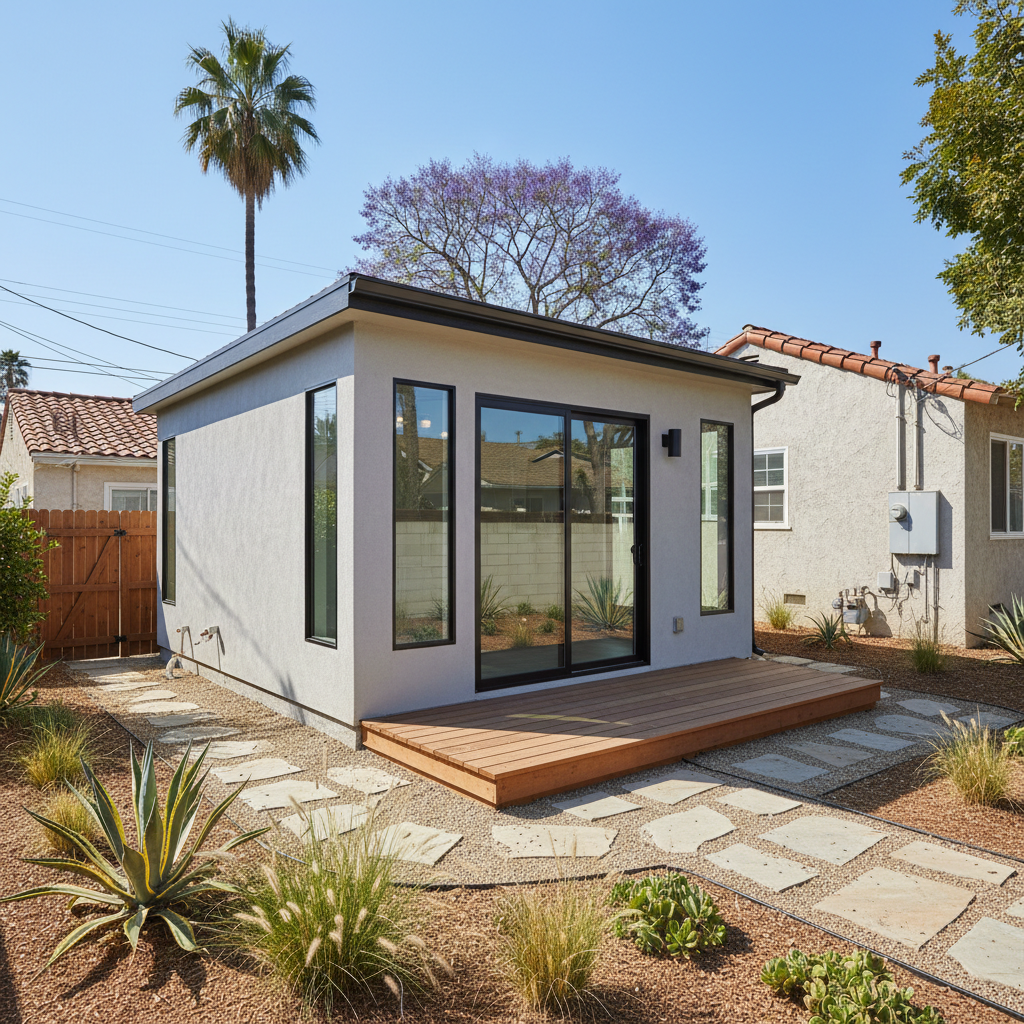
So, you're thinking about adding a Junior ADU (JADU) to your property. And, naturally, the first thing that pops into your head is probably, "What's this actually going to set me back?" It's a totally fair question, and honestly, a lot of what you find online is either super vague or just plain wrong. I've been building these things for years here in LA, and I've got a pretty good feel for the numbers.
What Even Is a JADU, Anyway?
Before we start talking money, let's just quickly clear this up. A Junior ADU is a smaller, self-contained living space, usually built right into your main house's existing footprint. It's typically no more than 500 square feet, has its own entrance, a kitchen (often just a wet bar with a sink and a few appliances, not a full-on range), and a bathroom. The big difference from a regular ADU? It has to be inside your house's current walls and share a wall with the main dwelling. You can't build a new, separate structure for a JADU.
What Makes JADU Costs Go Up or Down?
Look, there's no single price for a JADU. Anyone who tells you there is? They're probably trying to sell you something. The cost really depends on a few key things:
- The Space You're Starting With: This is a huge one. Are we converting a spare bedroom that already has plumbing nearby? Or are we ripping out an old, unused laundry room that needs a total gut job, including new electrical panels and major plumbing reroutes? If you're starting with a finished room that just needs a kitchenette and a bathroom added, you're in a much better spot than if you're gutting an old den, wouldn't you agree?
- How Much Work You Want Done: Do you want basic finishes – laminate counters, standard cabinets, simple tile? Or are you dreaming of quartz, custom cabinetry, and fancy fixtures? Every upgrade adds to the bill.
- Structural Changes: Most JADUs don't need big structural work since they're inside existing spaces. But if you have to move load-bearing walls, add new windows or doors in tricky spots, or reinforce floors, that's definitely going to make your bill jump significantly.
- Permitting and Design Fees: You just can't skip these. You'll need architectural plans, sometimes engineering, and city permits. Los Angeles Department of Building and Safety (LADBS) fees aren't cheap, and getting through the process requires really detailed plans.
- Utility Upgrades: While JADUs often share utilities with the main house, you might need to upgrade your electrical panel to handle the extra load. Or maybe you'll need to run new water lines if your chosen space is far from the existing plumbing.
What a JADU Really Costs in LA: Realistic Ranges
Alright, let's get down to business. Based on what I've seen across different neighborhoods, from the hills of Silver Lake to the flats of the Valley, here's a general breakdown:
- Basic JADU Conversion (Minimal Changes): If you're converting a room that's already got good bones, like a big master bedroom with an attached bathroom, and you're just adding a kitchenette/wet bar, new flooring, and paint, you might be looking at $60,000 to $95,000. This assumes minimal plumbing or electrical rerouting and standard finishes.
- Mid-Range JADU Conversion (The Typical Scenario): This is where most projects land. You're taking an existing space, maybe a den or a couple of smaller bedrooms, and really transforming it. This involves more significant plumbing and electrical work, possibly moving a non-load-bearing wall, adding a dedicated entrance, and mid-grade finishes. For this, you're usually in the $95,000 to $150,000 range.
- High-End or Complex JADU: If you're going for premium finishes, custom features, or if the existing space needs more extensive modifications (say, adding a new window opening in a stucco wall, or a major electrical panel upgrade), you could easily hit $150,000 to $200,000+.
These numbers cover design, permits, materials, and labor. Remember, these are rough estimates. Your specific project could be higher or lower.
What Should Be in Your Quote?
When you get a quote from a contractor, make sure it's really detailed. It should clearly spell out:
- Design & Permitting: Costs for architectural drawings, engineering (if you need it), and city permit fees.
- Demolition: Exactly what's being removed.
- Framing: Any new walls or modifications.
- Plumbing: New lines for the kitchen sink, bathroom, water heater.
- Electrical: New circuits, outlets, lighting, panel upgrades.
- HVAC: Often a mini-split system for a JADU.
- Insulation: Walls, ceiling, floor (if it applies).
- Drywall & Paint: Finishing the inside.
- Flooring: Your choice of material and how it's installed.
- Cabinetry & Countertops: For the kitchenette and bathroom vanity.
- Appliances: Often includes a smaller fridge, microwave, and cooktop.
- Windows & Doors: Any new openings or replacements.
- Bathroom Finishes: Tile, shower/tub, toilet, vanity.
- Cleanup & Hauling: Don't forget this; it's part of the job.
A good contractor, like us at Los Angeles ADU Solutions Inc., will break this down so you know exactly what you're paying for.
How to Avoid Paying Too Much
Nobody wants to get ripped off, especially not on a big project like this. Here are my tips:
- Get Multiple Bids: Don't just go with the first person you talk to. Get at least three detailed quotes from reputable, licensed contractors. Compare them line by line.
- Be Specific About Finishes: The more you know exactly what you want (e.g., "I want this specific brand of LVP flooring," not just "nice floors"), the more accurate your quotes will be. Changes mid-project are where costs really explode.
- Ask for References and Check Licenses: Always, always, always check their CSLB license. Talk to past clients.
- Understand the Contract: Read every single word. Make sure everything you discussed is in writing, including payment schedules and how change orders will be handled.
- Don't Automatically Go for the Cheapest Bid: If one bid is way lower than the others, there's usually a reason. They might be cutting corners, using cheaper materials, or they've just missed something important in the scope. Quality work isn't always the cheapest upfront, but it saves you headaches and money down the road.
Building a JADU is a smart investment in Los Angeles. Just make sure you go into it with your eyes wide open about the costs, and you'll be set up for success.